Regulation
NIS 2 compliance automation: what to automate under Article 21
November 24, 2026 · 10 min read
NIS 2, Directive (EU) 2022/2555, asks essential and important entities to manage cybersecurity risk and report significant incidents on a fixed clock. Member states had to apply their national laws from 18 October 2024. Many were late: the Commission opened infringement procedures against 23 member states in November 2024, so the exact rules and start dates still depend on the countries where you operate (transposition status). If you are not yet sure you are in scope, start with who NIS 2 applies to.
This guide is for teams that have confirmed scope and now have to run the program. For each of the ten Article 21 measures it answers one question: what can a tool check on a schedule, and what still needs a person?
What NIS 2 actually asks you to do
Article 21(1) asks for appropriate and proportionate technical, operational and organisational measures. Proportionate is the key word: the directive weighs your exposure to risk, your size, and the likelihood and severity of incidents. Article 21(2) then sets an all-hazards baseline of ten measures that every in-scope entity must cover at minimum:
- (a) policies on risk analysis and information system security
- (b) incident handling
- (c) business continuity, such as backup management and disaster recovery, and crisis management
- (d) supply chain security, including the security of relationships with direct suppliers and service providers
- (e) security in network and information systems acquisition, development and maintenance, including vulnerability handling and disclosure
- (f) policies and procedures to assess the effectiveness of the measures
- (g) basic cyber hygiene practices and cybersecurity training
- (h) policies and procedures on cryptography and, where appropriate, encryption
- (i) human resources security, access control policies and asset management
- (j) multi-factor or continuous authentication, secured voice, video and text communications, and secured emergency communications, where appropriate
Three more articles shape the work. Article 21(4) says that when you find a gap, you take corrective measures without undue delay. Article 20 says the management body approves the measures, oversees them, can be held liable, and must follow cybersecurity training. Article 23 sets the incident reporting deadlines.
For one group of digital providers, the rules are more specific. Commission Implementing Regulation (EU) 2024/2690 sets the technical and methodological requirements for DNS service providers, TLD name registries, cloud computing and data centre providers, content delivery networks, managed service and managed security service providers, online marketplaces, search engines, social networking platforms and trust service providers. ENISA published technical implementation guidance for it in June 2025, with examples of evidence. Even if you are not on that list, it shows what a supervisor will likely consider reasonable.
The ten measures, sorted by how much you can automate
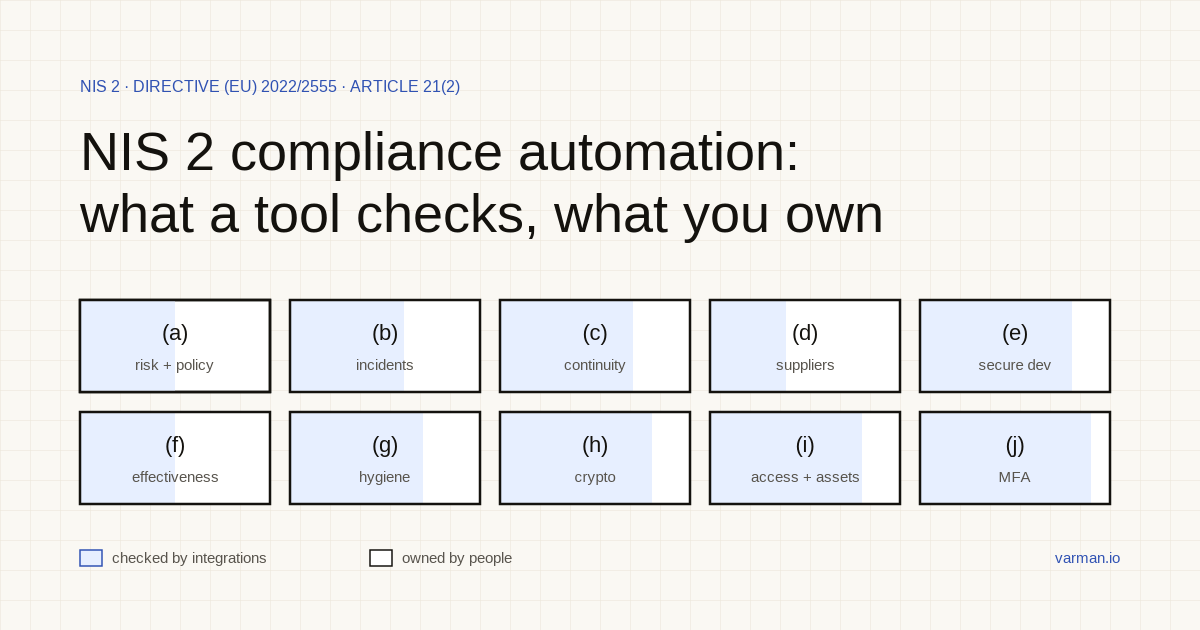
Compliance automation means three things in practice: pulling configuration evidence from your systems on a schedule, flagging when a setting drifts, and keeping the record of who did what and when. It does not mean a tool decides your risk appetite or picks your suppliers. The table below splits each measure along that line.
| Measure | A tool can check on a schedule | People still own | Automation fit |
|---|---|---|---|
| (a) Risk analysis and policies | Policy versions, review dates, employee acknowledgements | Risk scoring, treatment decisions, policy content | Partial |
| (b) Incident handling | On-call escalation policies exist, incident tickets and timestamps | Deciding if an incident is significant, the report itself | Partial |
| (c) Continuity and backups | Backups enabled and retained, database backup settings | Restore tests, crisis plan, recovery targets | High for backups, low for crisis |
| (d) Supply chain | Vendor list completeness, review due dates | Supplier risk judgment, contract terms | Low |
| (e) Secure development | Branch protection, required reviews, dependency and code scanning | Disclosure policy, fixing what scans find | High |
| (f) Effectiveness | Control pass rates over time, failed checks | Internal audit, management review, pentest scope | Partial |
| (g) Hygiene and training | Training completion, phishing simulation results, device settings | Training content, follow-up with people | High |
| (h) Cryptography | Encryption at rest, TLS enforcement, HTTPS redirects | Key management policy, algorithm choices | High |
| (i) HR, access, assets | Joiners and leavers synced from HR, access reviews, asset inventory | Approving access, background checks where lawful | High |
| (j) MFA and secure comms | MFA enforced in identity provider and code host | Choosing secure voice and emergency channels | High for MFA |
Where automation does the most work
Measures (e), (g), (h), (i) and (j) are mostly about settings that live in systems you already use. That is where scheduled checks pay off. Examples of checks Varman runs through its integrations: MFA enrollment policy active in Okta (see the Okta compliance integration), 2-step verification in Google Workspace, MFA enforced in Microsoft 365, branch protection and Dependabot security updates on GitHub, S3 default encryption and CloudTrail log validation on AWS, HTTPS and end-to-end TLS on Cloudflare, and device key expiry on Tailscale. The Google Cloud integration is coming soon, with checks such as Cloud SQL backups and encryption. A failed check becomes a task with an owner and a due date, which is how you show Article 21(4) corrective action instead of just claiming it.
Where people stay in charge
Measures (a), (d) and (f) are judgment work. A tool can remind you that a supplier review is due or that the risk register has not been touched in six months. It cannot tell you whether a supplier is acceptable. Article 21(3) asks you to consider the vulnerabilities specific to each direct supplier and the quality of their security practices, including secure development. That takes a questionnaire, a document review and a decision someone signs.
Endpoints and NIS 2
There is no single endpoint article in NIS 2. Laptops and servers show up across four measures: asset management in (i), cyber hygiene in (g), encryption in (h) and authentication in (j). A practical endpoint baseline for NIS 2 evidence:
- An inventory of every device that touches production or customer data, with an owner.
- Disk encryption on, screen lock on, operating system updates applied within your policy window.
- Endpoint protection running and reporting.
- MFA for every account that reaches company systems from that device.
- A leaver process that removes access and recovers or wipes the device.
Your device management tool already knows most of this. The compliance work is to pull that state on a schedule, keep the history, and tie it to the right measure. Varman keeps people, training and device checks in the same platform as the controls they support.
How automated evidence flows
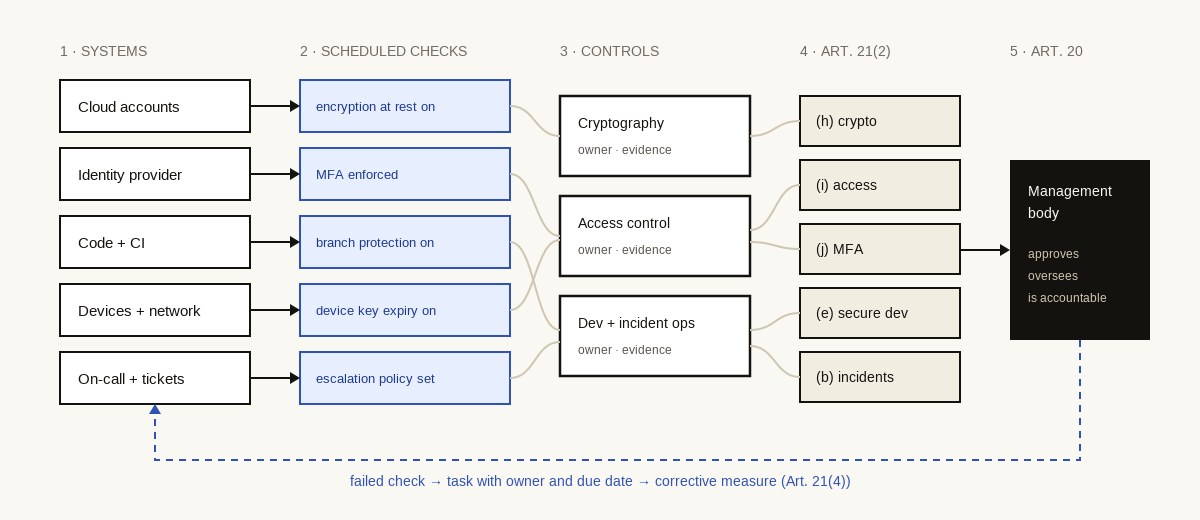
A check turns system state into pass or fail. A control groups related checks and carries an owner, a policy and the evidence, then maps to the Article 21 measure it supports. The management body looks at measures, not at S3 buckets.
Keeping controls in the middle is what lets you reuse work. The same MFA control supports NIS 2 point (j), ISO 27001 Annex A 8.5 and SOC 2 CC6.1. In Varman, all prebuilt frameworks share one control set, so evidence collected once counts toward every framework mapped to that control.
Incident reporting: automate the clock, not the call
Article 23 is where teams feel the deadlines. A significant incident is one that has caused or can cause severe operational disruption or financial loss for you, or considerable material or non-material damage to others. Once you are aware of one, the clock starts.
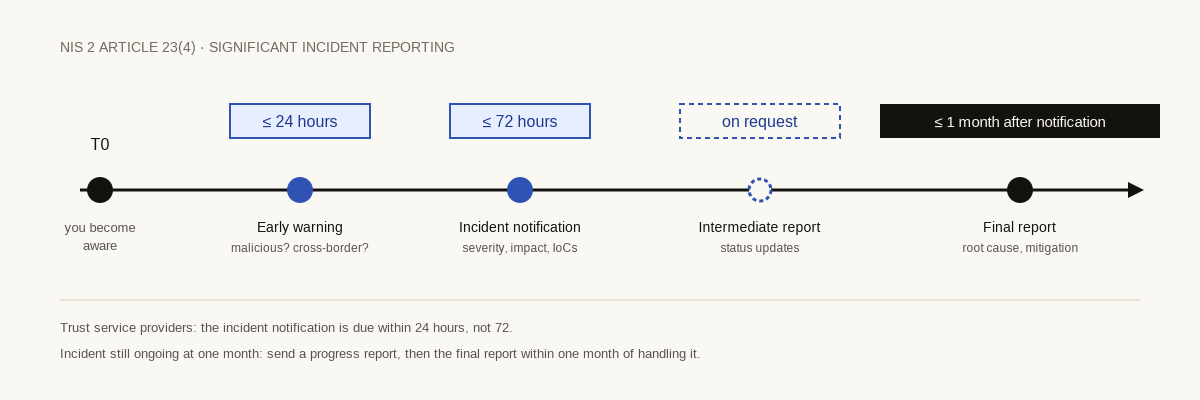
- Early warning, within 24 hours of becoming aware: say whether the incident is suspected to be malicious or could have a cross-border impact.
- Incident notification, within 72 hours: update the early warning, give an initial assessment of severity and impact, and include indicators of compromise where available. Trust service providers have 24 hours for this step.
- Intermediate report, when the CSIRT or competent authority asks for one.
- Final report, no later than one month after the incident notification: a detailed description, the likely root cause, the mitigation applied and ongoing, and any cross-border impact. If the incident is still running, send a progress report instead and the final report within one month of handling it.
What to automate here: paging through your on-call tool, an incident record that timestamps when someone became aware, a template for each report with the fields above, and reminders tied to the 24 hour, 72 hour and one month marks. What not to automate: the decision that an incident is significant. That needs a named person with the authority to make the call at 3 a.m., written into your incident response plan.
Management accountability is not a checkbox
Article 20 is the measure most teams underestimate. The management body approves the cybersecurity measures, oversees how they are carried out, and can be held liable when the entity breaches Article 21. Its members must also follow training. Article 34 sets maximum fines of at least 10 million euros or 2 percent of worldwide annual turnover for essential entities, and at least 7 million euros or 1.4 percent for important entities, whichever is higher.
Automation helps the board see the program. A quarterly view of control status by Article 21 measure, open corrective tasks, incidents and training completion gives directors something concrete to approve and minute. The approval and the minutes are the evidence. Keep them.
A 90-day rollout plan
- Days 1 to 15: confirm scope under the national law that applies, name an owner for each Article 21 measure, and list the systems that hold evidence.
- Days 16 to 45: connect identity, cloud, code, device and on-call tools; turn on scheduled checks; adopt or update policies for each measure and collect employee acknowledgements.
- Days 46 to 70: run a risk assessment, build the supplier list with review dates, write the incident reporting procedure with the Article 23 clocks, and run one tabletop exercise against it.
- Days 71 to 90: run a penetration test, fix what it finds, and take the first status report to the management body for approval.
Reuse what you already have
NIS 2 does not require ISO 27001 certification, but the overlap is large. Annex A covers policies (5.1), incident management (5.24 to 5.28), continuity and backup (5.29, 5.30 and 8.13), supplier relationships (5.19 to 5.22), vulnerabilities and secure development (8.8 and 8.25 to 8.28), awareness training (6.3), cryptography (8.24), access control (5.15 to 5.18) and secure authentication (8.5). If you run an ISO 27001 ISMS, map it to Article 21 and fill the gaps, mostly the Article 23 reporting clocks and the Article 20 management duties.
Varman ships NIS 2 as a prebuilt framework with 160 requirements, 35 mapped controls and 27 policy templates, on the same control set as ISO 27001 and SOC 2. Penetration tests run on demand or on a schedule with findings kept beside the controls they affect, and phishing simulation results count as awareness evidence for point (g). See the NIS2 compliance tool for what is included, or work through the free NIS 2 checklist first.
Frequently asked questions
Can NIS 2 compliance be fully automated?
No. Automation covers evidence that lives in system settings, such as MFA, encryption, backups and access reviews. Risk decisions, supplier choices, the call that an incident is significant, and management approval under Article 20 stay with people.
Which NIS 2 measures benefit most from automation?
Secure development (e), cyber hygiene and training (g), cryptography (h), access and asset management (i) and multi-factor authentication (j). Their evidence is mostly configuration that a scheduled check can read.
What are the NIS 2 incident reporting deadlines?
An early warning within 24 hours of becoming aware of a significant incident, an incident notification within 72 hours, an intermediate report if the authority asks, and a final report no later than one month after the incident notification.
Does ISO 27001 certification mean we comply with NIS 2?
Not by itself, but it covers much of Article 21. You still need the Article 23 reporting process, the Article 20 management duties, and whatever your national law adds. Map your ISMS controls to the ten measures and close the gaps.
Related
See how Varman automates this for your team.
Book a demoKeep reading
NGINX HTTP/2 remote code execution bugs: what to patch and how to prove it
Two memory-safety bugs in the NGINX HTTP/2 module, CVE-2026-123007 and CVE-2026-123633, can let an unauthenticated attacker run code on the server. Fixed in 1.30.7 and 1.31.9. Here is who is exposed, what to do today, and the evidence your auditor will ask for.
SOC 2 compliance: the complete guide
What a SOC 2 report is, how the Trust Services Criteria work, Type I versus Type II, how to scope, what evidence auditors ask for, and how to keep it current between audits.