Security
NGINX HTTP/2 remote code execution bugs: what to patch and how to prove it
November 18, 2026 · 6 min read
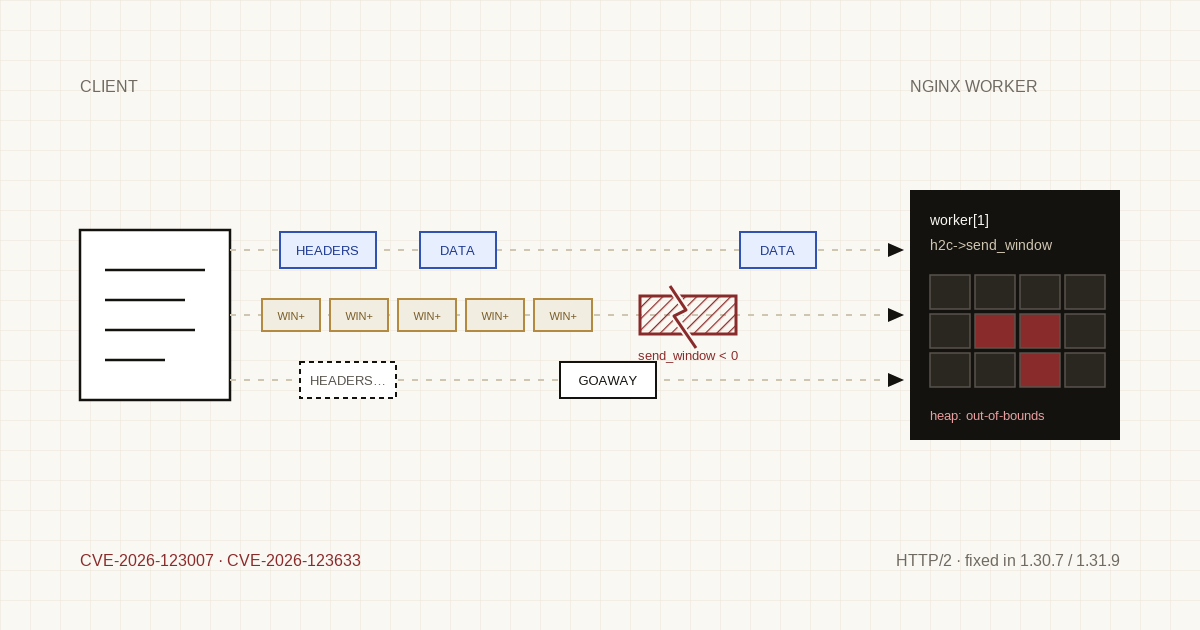
On November 18, 2026, F5 shipped a security release for NGINX that fixes two memory-safety bugs in its HTTP/2 implementation. Both can be reached by an unauthenticated client, and researchers at Wiz showed both leading to remote code execution on the server (Wiz write-up). Several other teams found the same bugs independently, which is a good reason to assume attackers are not far behind.
NGINX sits in front of a large share of the web as a web server, reverse proxy, load balancer and Kubernetes ingress controller. One vulnerable instance often fronts many applications, so a compromise there can reach all of them.
The two bugs
| CVE-2026-123007 | CVE-2026-123633 | |
|---|---|---|
| Type | Integer underflow in HTTP/2 flow control | Use-after-free of an HTTP/2 connection |
| First vulnerable NGINX | 1.9.5 (2015) | 1.19.7 |
| Fixed NGINX open source | 1.30.7 stable, 1.31.9 mainline | 1.30.7 stable, 1.31.9 mainline |
| nginx.org severity | Major | Medium |
| Conditions | HTTP/2 enabled; attacker sends a large number of WINDOW_UPDATE frames | HTTP/2 enabled; server running low on free connection slots, more likely on reverse proxies |
The disclosure gives both a CVSS 4.0 score of 9.2, while the nginx.org advisory list rates them Major and Medium. Treat them as critical anyway: the researchers demonstrated code execution and showed that address space layout randomization (ASLR) does not stop it, because the bugs can first be used to read memory.
CVE-2026-123007: the flow-control window goes negative
HTTP/2 lets each side tell the other how much data it may send, through a flow-control window. When a stream is cleaned up, NGINX hands its unused window credit back to the connection without checking the protocol maximum. A later bounds check uses unsigned arithmetic and wraps around, so the window ends up as a negative size. That size flows into the code that writes response data over TLS, which then copies outside its buffer.
The result is heap memory disclosure and corruption. According to the researchers, ordinary static files served over HTTPS are enough to reach the vulnerable path. No backend application or third-party module is needed.
CVE-2026-123633: a connection freed while still in use
While NGINX waits for the rest of a partially received HEADERS frame, it marks the connection as reusable, so it may reclaim it when connection slots run low. When the request stream is then created, the connection is not taken off that list. Under connection pressure NGINX can start closing it mid-request, and if sending the GOAWAY frame fails, the error path frees memory the request is still using.
Running out of connection slots is exactly what a busy reverse proxy does, and an attacker can push a server there on purpose.
The same release also fixes a use-after-free in HTTP/3 and one in the DNS resolver, both rated Medium (advisories). The upgrade below covers all four.
Are you exposed?
Check three things for every NGINX you run, including ones you did not install yourself:
- Version. Run
nginx -von hosts, or check the image tag of containers and ingress controllers. Open source releases older than 1.30.7 on the stable branch, or 1.31.9 on mainline, are affected. - HTTP/2. Look for
http2 on;orlisten 443 ssl http2;in the configuration (nginx -Tprints the full config). Many default TLS setups turn HTTP/2 on. - Reachability. A CDN or WAF that terminates HTTP/2 in front of NGINX may reduce exposure, depending on how it talks to the origin. An origin that is also reachable directly is still exposed.
Places teams forget: Kubernetes ingress controllers built on NGINX, vendor appliances and container images that bundle it, sidecars and API gateways, and staging environments with public addresses.
What to do today
- Upgrade. Move NGINX open source to 1.30.7 or 1.31.9 (downloads), apply the fixed NGINX Plus build, or take your distribution or image vendor's patched package. For ingress controllers, upgrade to a release that bundles a fixed NGINX.
- If you cannot upgrade right away, disable HTTP/2. On NGINX 1.25.1 or later set
http2 off;in the affected server blocks. On older versions removehttp2from thelistendirectives. Test clients, reload, and make sure old worker processes have exited. - Confirm. Check the running version after the change, not just the package, and test that HTTP/2 negotiation behaves as expected.
- Watch. Unexpected NGINX worker crashes, commands started by the NGINX user, and long-lived HTTP/2 connections pushing large volumes of data are worth investigating. None of these is a confirmed indicator on its own.
- Re-enable HTTP/2 once every exposed instance runs a fixed version.
Turning the fix into audit evidence
A fast patch is good security. A fast patch with a record behind it is also good compliance. Vulnerability management shows up in every major framework, and auditors test it by sampling events exactly like this one.
| Framework | Where this lands |
|---|---|
| SOC 2 | CC7.1 (detecting vulnerabilities) and CC8.1 (change management) |
| ISO 27001 | Annex A 8.8 (management of technical vulnerabilities) and 8.32 (change management) |
| PCI DSS | Requirement 6.3.3 (critical patches within one month of release) |
| NIST CSF | ID.RA-01 (vulnerabilities identified) and PR.PS-02 (software maintained) |
For an event like this, the evidence that holds up is simple: when you learned about the advisory, which assets were affected, the ticket with an owner and due date, the change record, and proof of the fixed version afterwards. If you used the HTTP/2 workaround first, keep that change too, along with the date you reverted it. Make sure the patch timeline matches the window your own vulnerability management policy promises, since auditors compare the two.
In Varman, you can log the issue as a finding against your vulnerability management control, track the remediation task to closure, and attach the scan output and version check as evidence. Scheduled penetration tests and continuous monitoring then help show that the fix stayed in place.
To see how a finding like this one moves from scan to closed task and stored evidence, book a demo and we will walk through it against your own frameworks.
Frequently asked questions
Which NGINX versions fix CVE-2026-123007 and CVE-2026-123633?
NGINX open source 1.30.7 on the stable branch and 1.31.9 on mainline. NGINX Plus customers should apply the fixed builds listed in the F5 advisory.
Am I affected if HTTP/2 is turned off?
Both bugs need HTTP/2 to be enabled. If no server block has HTTP/2 on, these two bugs do not apply, but the same release also fixes HTTP/3 and resolver bugs, so upgrade anyway.
Does a CDN or WAF protect me?
Partly. A service that terminates HTTP/2 itself and talks to your origin separately may block the attack, depending on how it is built. An origin that can also be reached directly is still exposed.
How fast should we patch for SOC 2 or ISO 27001?
Neither standard sets a fixed number of days. Your own vulnerability management policy does, and auditors check that you met it. PCI DSS asks for critical security patches within one month of release.
Related
See how Varman automates this for your team.
Book a demoKeep reading
NIS 2 compliance automation: what to automate under Article 21
NIS 2 compliance automation, measure by measure: which Article 21 controls a tool can check for you, what stays manual, and the evidence for 24h and 72h reporting.
SOC 2 compliance: the complete guide
What a SOC 2 report is, how the Trust Services Criteria work, Type I versus Type II, how to scope, what evidence auditors ask for, and how to keep it current between audits.